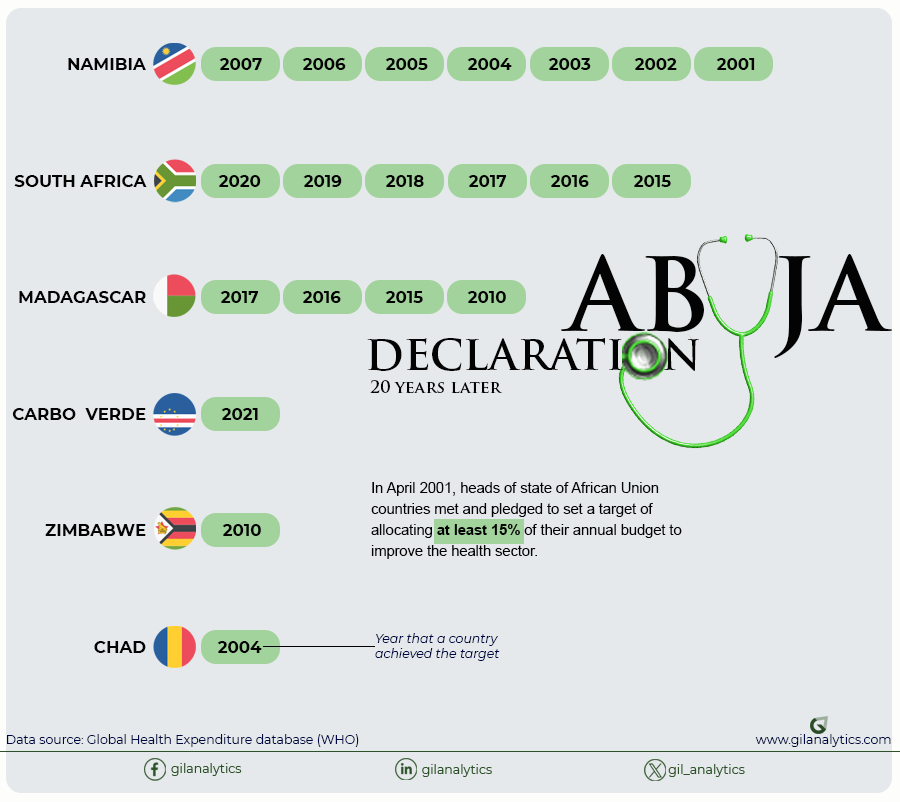
In April 2001, African Union (AU) member states signed a declaration to allocate at least 15% of their national budgets to the health sector. It is commonly referred to as the Abuja declaration since the signing took place in Abuja, Nigeria, with a primary goal of strengthening healthcare systems to improve the overall health outcomes in Africa. We tracked when countries have achieved the 15% target between 2001 – 2021 using data from the WHO Global Health Expenditure Database.
Download the Abuja declaration here
More than two decades after that historic meeting in Nigeria, the target remains largely elusive. Tracking two decades of data from the World Health Organization (WHO) Global Health Expenditure Database reveals that the vast majority of African nations are still struggling to cross even the 10% threshold.
South Africa – which is the largest economy in the continent – is among the six countries have ever met the 15% goal since 2001 in the continent.
Tracking the Success Stories
While overall compliance is low, a few nations have successfully hit the mark. The table below details the specific years and expenditures where countries hit or exceeded the 15% Abuja target:
| Country | year | GGHED_GGE (%) | GGHED (USD) |
|---|---|---|---|
| Cabo Verde | 2021 | 15.8 | 9,277 |
| Chad | 2004 | 15.0 | 50,622 |
| Madagascar | 2010 | 15.2 | 389,695 |
| Madagascar | 2015 | 15.3 | 661,039 |
| Madagascar | 2016 | 17.5 | 892,743 |
| Madagascar | 2017 | 15.0 | 922,244 |
| Namibia | 2001 | 16.0 | 1,511 |
| Namibia | 2002 | 17.2 | 1,831 |
| Namibia | 2003 | 16.8 | 1,968 |
| Namibia | 2004 | 17.4 | 2,125 |
| Namibia | 2005 | 16.3 | 2,100 |
| Namibia | 2006 | 15.8 | 2,250 |
| Namibia | 2007 | 18.0 | 2,888 |
| South Africa | 2014 | 14.9 | 180,798 |
| South Africa | 2015 | 15.2 | 203,194 |
| South Africa | 2016 | 15.3 | 217,653 |
| South Africa | 2017 | 15.3 | 231,847 |
| South Africa | 2018 | 15.3 | 247,256 |
| South Africa | 2019 | 15.3 | 270,014 |
| South Africa | 2020 | 15.3 | 294,336 |
| South Africa | 2021 | 15.3 | 309 356 |
| Zimbabwe | 2010 | 15.2 | 332 |
GGHED (USD): Domestic General Government Health Expenditure
GGHE_GGE: Domestic General Government Health Expenditure as % General Government Expenditure
Key Takeaways
- Pioneers and Slippage: Namibia aggressively met the target immediately following the declaration, sustaining over 16% allocation for four consecutive years before dipping back below the threshold.
- A Modern Benchmark: Cabo Verde is the most recent addition to the successful cohort, hitting 15.8% in 2021 (a surge heavily influenced by global pandemic response efforts).
Ultimately, the data shows that while the Abuja Declaration set an excellent baseline for health policy, transforming political will into long-term fiscal commitment remains a critical challenge for the continent.
FAQs
While political will is often cited, the primary barrier is structural economics. Many African countries operate on highly constrained fiscal budgets heavily burdened by rising international debt service costs. Additionally, lower tax-revenue collection rates limit the absolute size of the national budget, forcing governments to make impossible trade-offs between financing healthcare, education, national security, and critical infrastructure.
When public health budgets are low, the financial burden shifts directly to citizens. In sub-Saharan Africa, out-of-pocket health spending averages roughly 36% of all healthcare costs, and reaches as high as 67% in some nations. Because most people do not have health insurance, a single medical emergency can completely deplete a family’s savings, pushing vulnerable households into extreme poverty.
The continent faces a complex, dual burden of disease that heavily strains its infrastructure:
- Persistent Communicable Diseases: Long-standing battles against malaria, HIV/AIDS, and tuberculosis continue. Simultaneously, emergency response systems are regularly tested by sudden outbreaks. For example the 2026 Central Africa Ebola epidemic (caused by the Bundibugyo virus) spreading across parts of the Democratic Republic of the Congo and Uganda, alongside localized surges in climate-driven cholera.
- The Rise of Non-Communicable Diseases (NCDs): Driven by shifting lifestyles and urbanization, chronic conditions like cardiovascular disease, diabetes, and cancers are rising rapidly, now making up an increasing share of the continent’s total disease burden.
- Maternal and Neonatal Mortality: While child survival rates past age five have steadily improved, sub-Saharan Africa still tragically accounts for nearly 70% of global maternal deaths, a gap worsened by localized conflicts and healthcare fragmentation.
