What is artificial intelligence?
Artificial Intelligence (AI) is rapidly transforming the world, influencing how we work, communicate, and make decisions. This raises an important question: will artificial intelligence harm humans in the future? Understanding the AI impact on society requires examining both risks and opportunities.
Artificial Intelligence (AI) refers to computer systems powered by machine learning algorithms that can perform tasks requiring human intelligence, such as learning, reasoning, and decision-making. As AI evolves, it is shaping the future of artificial intelligence and its impact on society.
Recent innovations, such as ChatGPT, Gemini, Grok and DeepSeek platforms, have accelerated adoption and sparked global conversations about both the benefits and risks of AI.
Why is AI a Global Debate?
AI continues to generate mixed reactions. While some see it as a tool for innovation and efficiency, others worry about its risks. These perceptions influence how AI is adopted and regulated across the world.
How Will AI Affect Humans in the Next 20 Years?
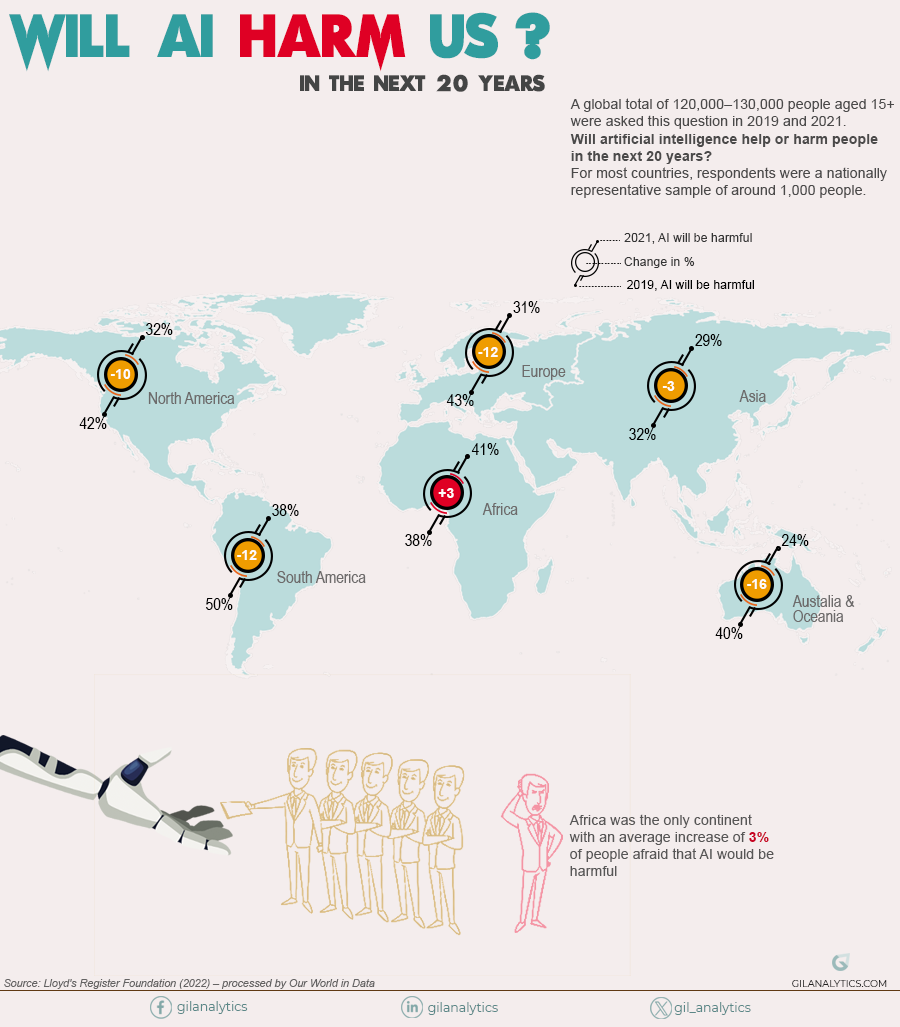
Surveys conducted by the Lloyd’s Register Foundation across 121 countries (2019 and 2021) provide key artificial intelligence statistics globally and in Africa. In 2021, the proportion of people who believed AI would cause more harm than good was:
- Africa (41%)
- South America (38%)
- North America (31%)
- Europe (31%)
- Asia (29%)
- Australia (24%)
Most regions saw declining concern compared to 2019, indicating growing optimism. However, Africa experienced a 3% increase, reflecting rising concern.
AI Trends in Africa and Developing Countries
Countries such as Sierra Leone, Tanzania, and Zimbabwe recorded increases of over 18% in concern about AI. In contrast, Algeria and Mali saw decreases of more than 16%.
These patterns highlight broader AI trends in Africa and AI adoption in developing countries, where perceptions vary significantly.
Public Perception of AI in Europe
In Europe, countries like Belgium, Greece, Spain, Switzerland, Georgia, and Germany reported declining fears, suggesting optimism. However, over half the population in North Macedonia, Albania, Serbia, and Kosovo still expressed concern.
AI Perception in North and South America
The United States and Canada both recorded reduced fear of AI. In South America, skepticism declined in Ecuador, Brazil, Jamaica, and Venezuela, although concerns remained in Paraguay, Uruguay, and Chile.
AI Perception in Asia
Countries such as Mongolia, Kazakhstan, and the Philippines saw reduced concern. However, more than half the population in Pakistan, Turkey, and Armenia remained worried.
Is Artificial Intelligence Dangerous to Humans?
Concerns about artificial intelligence risks continue to shape public opinion. While some believe is AI dangerous is a valid question, others argue that risks can be managed through proper governance and ethical frameworks.
Will AI Take Away Jobs in the Future?
A major concern is whether AI will replace human labor. The question will AI take away jobs in the future remains central to discussions about artificial intelligence and jobs, particularly in sectors involving repetitive tasks.
A Balanced View: Benefits and Risks of AI
Understanding the benefits and risks of AI is essential. While AI can drive efficiency, innovation, and better decision-making, it also raises concerns about inequality, bias, and misuse.
Is Artificial Intelligence Harmful to Society?
Ultimately, whether artificial intelligence is harmful to society depends on how it is developed and used. By addressing risks and promoting responsible innovation, AI can be harnessed to create positive outcomes globally.
The data above reflects the proportion of respondents who believe artificial intelligence will mainly harm society over the next 20 years, based on surveys conducted in 2019 and 2021.