
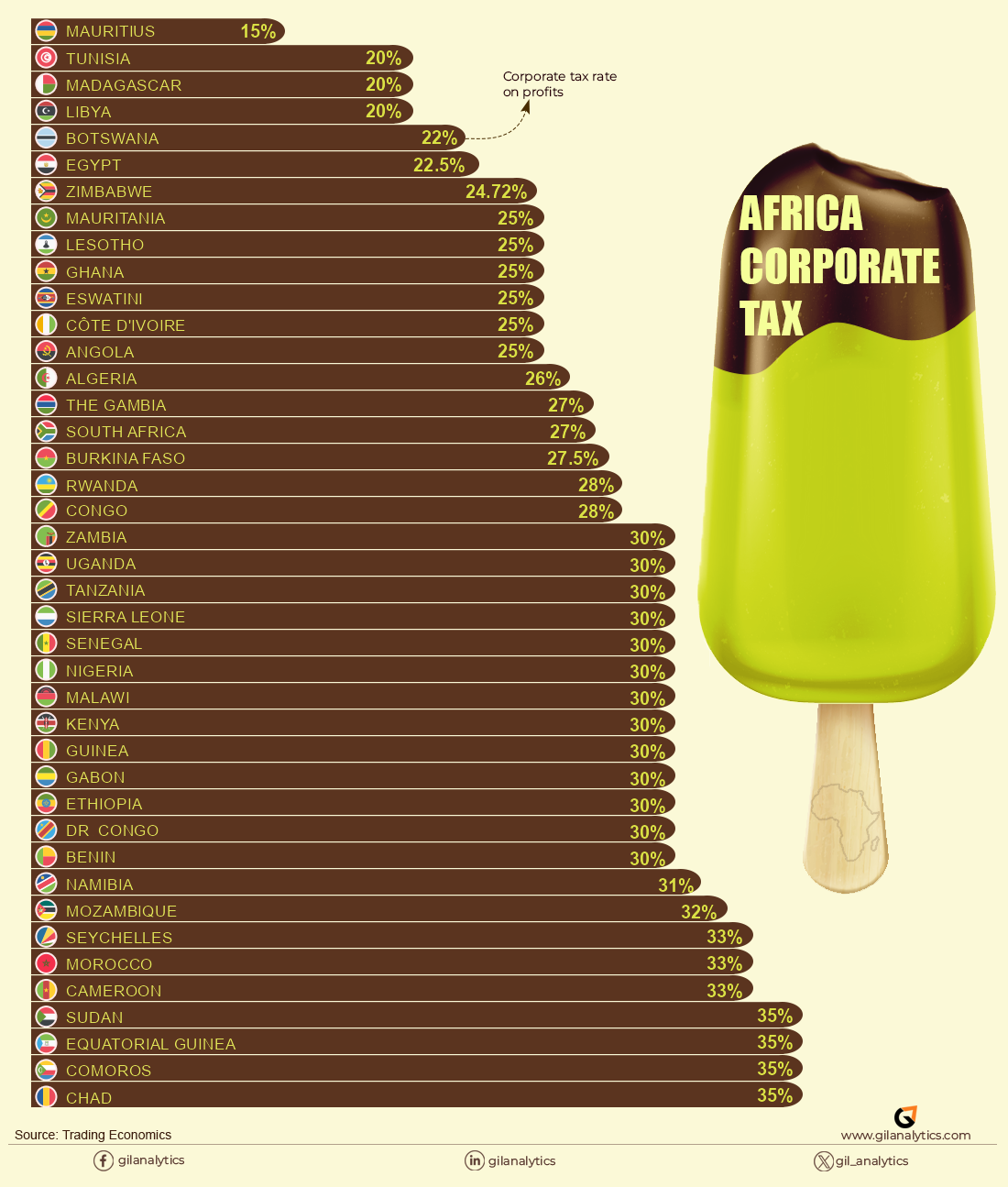
As African economies prioritize fiscal stability and investment attraction, corporate income tax (CIT) rates have largely stabilized. According to recent data from Trading Economics and the Tax Foundation, rates across 40 African nations typically range from 15% to 35%. With a continental average of 27–28%, Africa remains competitive with global emerging market standards. This guide breaks down the corporate income tax (CIT) rates, regional benchmarks, and what multinational enterprises (MNEs) need to know for the upcoming fiscal years.
Africa Tax Snapshot
- Lowest Rate: Mauritius (15%)
- Highest Rate: Chad, Comoros, Equatorial Guinea, Sudan (35%)
- Continental Benchmark: 30% (The most common rate)
The “30% Club”: The Continental Standard
The 30% CIT rate is the dominant benchmark in Africa. Countries like Kenya, Nigeria, and Ethiopia utilize this rate to balance revenue mobilization with investor interest. For businesses, this means the statutory rate is rarely the deciding factor when choosing between these specific markets; instead, the focus shifts to infrastructure and ease of doing business.
High-Tax Hubs (32%–35%)
Countries like Chad, Comoros, Equatorial Guinea, and Sudan maintain the highest headline rates at 35%. For Comoros, the normal corporate tax rate is 35%, which applies to both Comorian companies and foreign companies deriving Comorian-source income. However, public industrial and commercial enterprises or those where the state or certain public institutions are participants are subject to a corporate tax rate of 50 percent if their turnover exceeds 500 million Comorian francs.
Investor Note: In these regions, the headline rate is often offset by aggressive sector-specific incentives, particularly in the extractive industries (Oil, Gas, and Mining).
Low-Tax Hubs (15%–22.5%)
Mauritius continues to lead as the continent’s premier financial hub with a 15% rate. It is also among the richest countries in Africa. Meanwhile, South Africa has gained attention by maintaining its reduced 27% rate, a strategic move to regain its status as the most competitive gateway to the continent.
Corporate tax rates in Africa
Top 3 Corporate Tax Trends for 2025–2026
1. The 15% Global Minimum Tax (OECD Pillar Two)
The rollout of the OECD’s Pillar Two framework is a game-changer. Since most African nations already sit well above the 15% threshold, the “race to the bottom” has slowed. Many countries are now focusing on Domestic Top-up Taxes to ensure they collect the revenue rather than losing it to a parent company’s home jurisdiction.
2. Fiscal Policy Stability
Unlike the volatility seen in the early 2020s, the 2025–2026 period shows a trend of policy “settling.” Governments are prioritizing long-term stability over short-term rate hikes to encourage Foreign Direct Investment (FDI).
3. Shift Toward Indirect Taxation
As CIT rates stabilize, many African tax authorities are shifting their focus toward Value Added Tax (VAT) and digital service taxes to broaden the tax base without discouraging corporate investment.
Beyond the Headline Rate: What Actually Matters?
A 30% statutory rate rarely equals a 30% tax burden. When evaluating an African market, savvy investors must look at the Effective Tax Rate (ETR), which is influenced by:
- Free Trade Zones (FTZs): Jurisdictions like Egypt and Nigeria offer significant holidays for export-oriented businesses.
- Double Taxation Treaties (DTTs): Essential for reducing withholding taxes on dividends and interest.
- Transfer Pricing (TP) Enforcement: Revenue authorities in Kenya, South Africa, and Nigeria are becoming increasingly sophisticated in auditing cross-border transactions.
In 2026, the corporate tax landscape in Africa is defined by predictability and alignment. With a continental average of 27–28%, African nations are signaling to the global market that they are open for business, offering a stable environment that avoids the volatile “tax shocks” of previous decades.