For years, many global and local corporations viewed African data protection laws as “paper tigers”—regulatory frameworks with plenty of bark but no bite. That era ended definitively in 2024.
At Gil Analytics, we’ve tracked the shift from policy to penalty. The data reveals a staggering escalation in enforcement across the continent, signaling that African data sovereignty is no longer a buzzword; it is a multi-million dollar business reality. As of early 2026, the cost of a data breach is no longer just a line item; it’s a strategic risk.
The $220 Million Shockwave: Meta vs. Nigeria
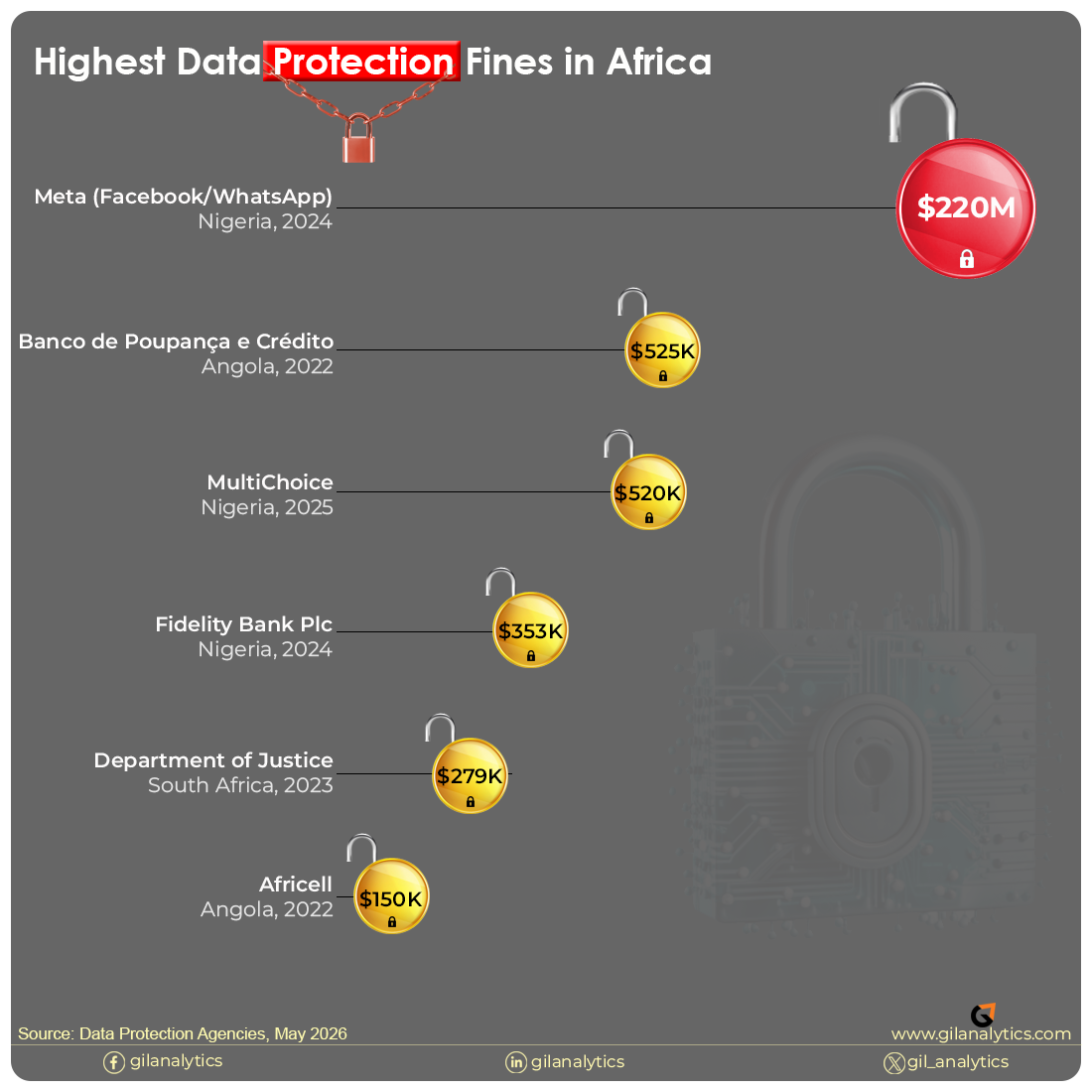
The most glaring data point in our recent analysis is the record-breaking $220 million fine leveled against Meta by the Nigeria Data Protection Commission (NDPC) and the FCCPC in 2024. Nigeria also has one of the largest economies in Africa.
This penalty, aimed at Meta’s discriminatory privacy policies and unauthorized data sharing, sent shockwaves through the global tech ecosystem. To put the scale in perspective, this single fine is over 400 times larger than the next highest penalty in the continent.
This wasn’t just a fine; it was a statement of intent. Nigeria is making it clear that Big Tech must respect local privacy standards or pay a premium for non-compliance.
Gil Analytics
Beyond Big Tech: Telecoms, Finance, and Government
While “Big Tech” grabs the headlines, our data shows that regulators are auditing every corner of the economy. Data breach penalties in Africa are becoming more sector-diverse:
- Finance: The banking sector—the traditional custodian of sensitive data—is under intense scrutiny. In Angola, Banco de Poupança e Crédito faced a $525,000 penalty for processing failures. Similarly, in 2024, Nigeria’s Fidelity Bank Plc was hit with a $353,020 fine for non-compliance with data protection audits.
- Telecommunications: Connectivity comes with responsibility. Africell in Angola was fined $150,000 as early as 2022, proving that the infrastructure of digital communication has been a primary target for years.
- Entertainment & Media: MultiChoice Nigeria recently faced a $520,000 fine from the NDPC, specifically regarding unauthorized cross-border data transfers—a key pillar of the Nigeria Data Protection Regulation (NDPR).
South Africa: Accountability for the Public Sector
In a rare move that bolstered the credibility of the Information Regulator (SA), enforcement isn’t just for the private sector. The South African Department of Justice faced a $279,000 (R5 million) penalty in 2023 following a ransomware attack and subsequent failure to implement mandated security upgrades. This highlights that POPIA enforcement in South Africa applies to everyone—from the smallest startup to the highest halls of government.
Angola: The New Frontier of Privacy Enforcement
While Nigeria and South Africa dominate the news, Angola is quietly becoming one of the most proactive regulators in the Lusophone world. With major fines in both the Telecom ($150,000) and Finance ($525,000) sectors, Angolan authorities are moving rapidly to align with international standards like the GDPR.
The amounts fined depends on the architecture of the penalties prescribed by the laws in the respective jurisdictions. In Kenya for instance, the maximum penalty is capped at Ksh 5 Million ($35,000) or 1% company’s turnover; whichever is lower. Thus far various entities have been hit with the maximum fines by the Office of the Data Protection Commissioner (ODPC).
What This Means for Business Strategy in 2026
The data privacy laws in Africa 2026 landscape are now characterized by “Zero Leniency.” If you are operating on the continent, your strategy should prioritize three things:
- Local Localization: Storing and processing data within the country of origin is becoming a legal necessity, not a choice.
- Audit Readiness: Regulators are now issuing fines for lack of registration and failed audits, even in the absence of a visible breach.
- Cross-Border Caution: Moving data across borders (even within Africa) requires explicit consent and rigid legal frameworks.
FAQs
The highest data protection fine in Africa is $220 million, issued to Meta in Nigeria in 2024 for discriminatory privacy practices. However, Meta did not pay this amount after a private settlement with the Nigerian government.
Nigeria, South Africa, Angola, and Kenya are currently leading the continent in high-value enforcement actions against both private and public sectors.”